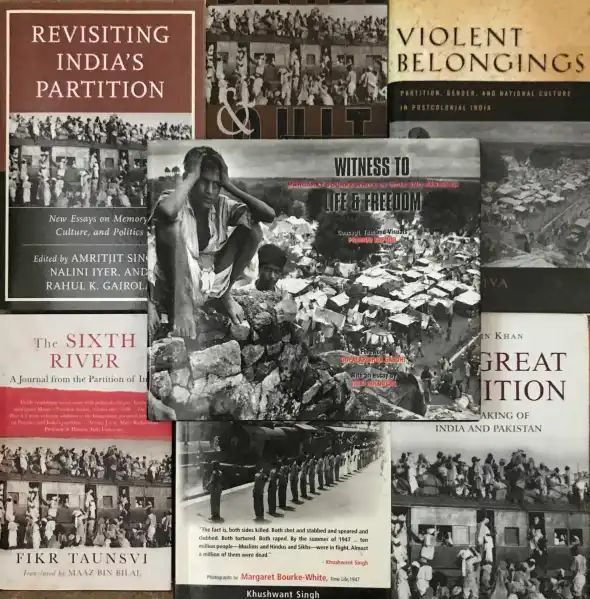
What historical event fascinates you the most?
History isn’t made by events alone
it’s made by people who lived through them.
Some carried borders in their bodies,
and some carried memories that refused to end.
 © Prachi Leheja
Some historical events don’t just belong to the past they linger in the air, in songs, in silence.
For me, that event is the Partition of India, 1947.
Not because of its political significance, but because of what it did to ordinary people. The Partition wasn’t only about the division of land it was about the division of hearts, languages, and identities. It was about millions who suddenly became strangers to their own homes overnight.
What fascinates me isn’t the maps or speeches; it’s the human aftermath. Borders were drawn on paper, but they ran far deeper through people’s minds, their dialects, and their memories.
The Human Side of History
When we study the Partition in textbooks, it’s presented as a transition India and Pakistan gaining independence.
But independence for some meant exile for others.
I’ve always been drawn to the stories that never made it into official records the ones whispered through generations.
A mother who buried her bangles before leaving home, promising she’d return.
A man who crossed a border and forgot what language to pray in.
A lover who wrote letters that never arrived.
These small, private moments form the real history the emotional history. The Partition fascinates me because it shows how fragile human identity can be how easily belonging can be rewritten.
Even decades later, the Partition isn’t over not emotionally.
It breathes through memories, through the nostalgia of children who never lived it but somehow feel it.
I’ve watched interviews with survivors who still cry when they describe what they left behind.
An old woman remembering her kitchen walls.
A man who still dreams of the house he never returned to.
It’s haunting how memory becomes inheritance.
Pain travels quietly through generations, until it becomes a part of who we are.
Sometimes, I think the Partition wasn’t just a historical divide. It was a lesson in how deeply human beings can hurt, and still rebuild. What always moves me most are the love stories. Those unfinished, fragile tales that no border can erase.
Two people grew up on the same street. They shared festivals, laughter, and language. Suddenly, they found themselves separated by faith, by fences, and by fear.
Many never saw each other again, yet carried their names in silence for a lifetime.
Those stories show both the cruelty and compassion of humanity. Amidst chaos, some chose to harm, but others chose to protect. Even in the darkest hour, kindness survived.
The Echo That Still Calls
Even today, if you walk through Punjab or Bengal, you can feel it the remnants of something that once was.
Architecture, food, and language still bear traces of both sides, as if the land remembers what people try to forget.
That’s what fascinates me most the way history breathes long after it’s written. The Partition was not just about lines drawn on maps. It was about how those lines drew themselves inside people.
The emotional displacement didn’t end in 1947; it lives on in stories, songs, and silence.
Every generation since then has inherited a version of that ache even those who weren’t there.
And maybe that’s the true legacy of Partition. It serves as a reminder that what we divide with politics. The heart keeps trying to heal with memory.
It makes me think about how easily we categorize history. We focus on dates, decisions, and leaders. We often forget the most important part: the people.
History isn’t just what happened.
It’s what remained.
And the Partition remains not in headlines, but in humanity.
It continues to fascinate me because it’s more than an event; it’s an emotion.
It forces us to look at ourselves. We question how something as vast as a homeland can become so fragile. We also question how something as soft as love can survive such sharp boundaries.
Maybe history isn’t about remembering what happened.
Maybe it’s about remembering how it felt.
And the Partition of India still feels incomplete even after all these years. It continues to echo in the hearts of those who never stopped belonging to both sides.




Leave a Reply